An open-plan home gives you more room to live, entertain and keep an eye on the family, but it can also leave furniture looking as though it is floating in one large space. The right rugs for open plan rooms create order without putting up walls. They set out where the lounge begins, where the dining table belongs and where everyone can relax in comfort.
A rug is more than a finishing touch. In a combined living, dining and kitchen area, it is one of the easiest ways to make each part of the room feel purposeful, warm and pulled together. The key is choosing sizes, colours and materials that suit both the layout and the way your household really lives.
Start by creating zones, not matching every rug
Open-plan rooms work best when each activity has its own visual boundary. A large rug beneath the sofa and coffee table can anchor the living area, while another under the dining setting clearly separates mealtimes from movie nights. If you have a study nook or reading chair nearby, a smaller rug can make that corner feel intentional rather than leftover.
Your rugs do not need to be identical. In fact, matching every pattern and colour too closely can make a large room feel staged. Instead, choose rugs that share a connection. This might be a similar warm neutral base, touches of the same blue or green, or a repeated texture such as a low pile weave. The result feels coordinated while allowing each zone to have its own character.
Think about the sightlines from your kitchen bench, hallway and entry. You want the rugs to guide the eye through the room, not compete for attention. In most homes, one statement rug paired with a quieter complementary design is easier to live with than several bold patterns in the same space.
Choose the right rug size before choosing the pattern
The most common mistake with rugs in an open-plan layout is buying too small. A small rug in the middle of a generous living room can make even beautiful furniture look disconnected. Bigger is usually better, provided it leaves a clear border of flooring around the edge of the zone.
Living room rug sizing
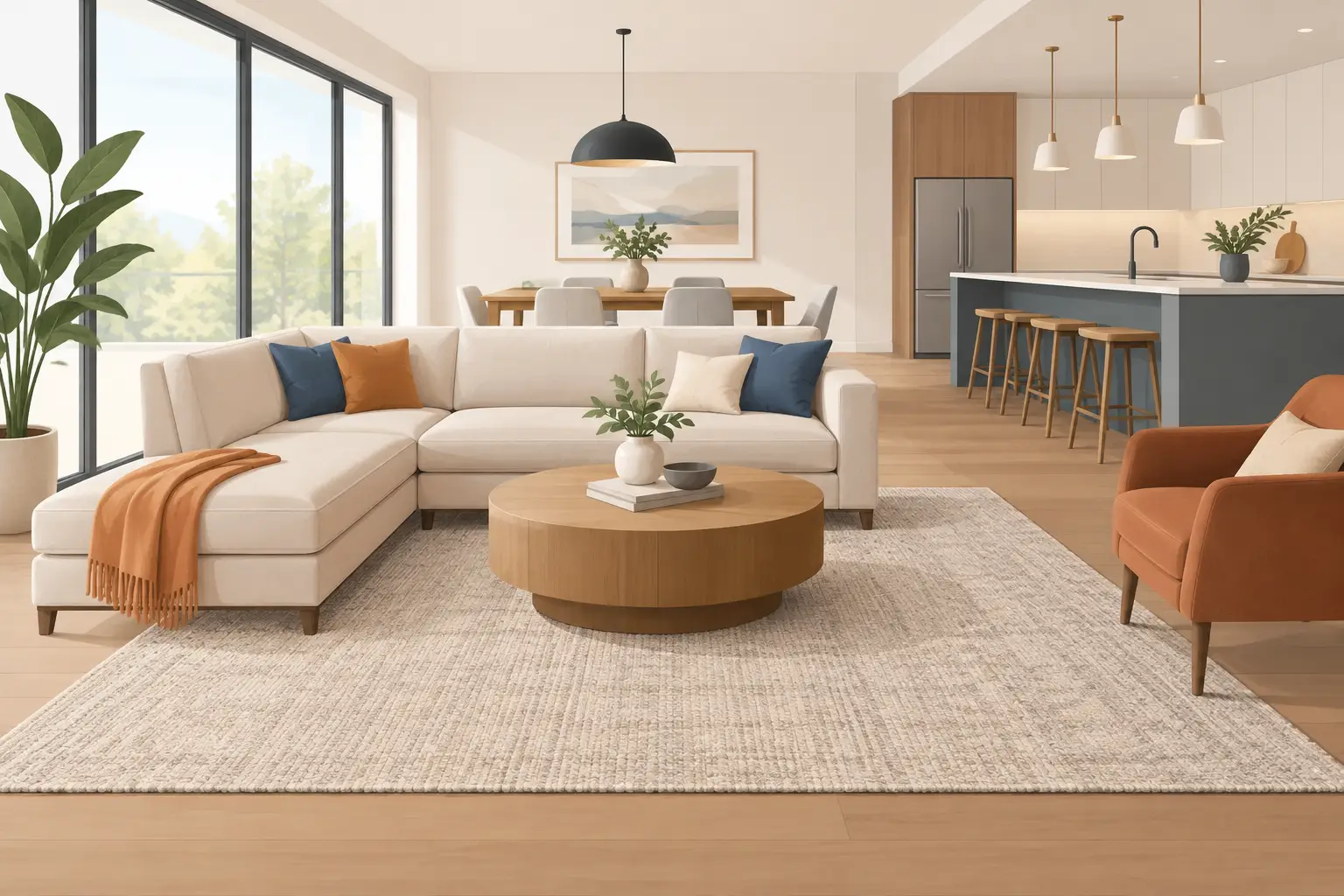
For a lounge area, aim to have at least the front legs of your sofa and occasional chairs sitting on the rug. This visually gathers the seating together and creates a generous, welcoming space. If your room allows it, a rug large enough to sit under all furniture legs gives an especially polished result.
A 160 x 230 cm rug can suit a compact apartment-style lounge or a small sitting area. For many family living rooms, 200 x 290 cm or 240 x 330 cm is a more comfortable starting point. Measure your sofa, coffee table and chair placement first, then mark the proposed rug dimensions on the floor with painter’s tape. It is a simple step that prevents a disappointing fit.
Dining room rug sizing
Under a dining table, the rug needs to extend beyond the table on every side so chairs remain on it when pulled out. Allow roughly 60 to 70 cm from the edge of the table to the edge of the rug where possible. This gives guests room to move their chairs without catching on the rug edge.
Round dining tables usually look best with a round rug, although a square rug can work in a more structured space. Rectangular tables are generally most comfortable on a rectangular rug that follows their shape. If your dining area doubles as homework central or a gathering spot for family dinners, prioritise a flat, easy-clean surface over a deep pile.
Select materials for real family life
The best-looking rug is not necessarily the best choice if it makes everyday cleaning stressful. Consider where spills, shoes, pets and high foot traffic are most likely, particularly in a home where the kitchen, dining and lounge areas all connect.
Low-pile rugs are a practical option beneath dining tables and in busy walkways. They are easier to vacuum, chairs slide more smoothly across them, and crumbs do not disappear deep into the fibres. Textured flatweaves also bring interest without adding bulk.
In a living zone, a soft medium-pile rug can add the cosy feel many open spaces need. It softens the sound of footsteps, makes floor play more comfortable and balances hard surfaces such as timber, tile and stone. If you love the plush feel of a thicker rug, save it for a low-traffic sitting area rather than placing it directly under dining chairs.
For households with children or pets, a patterned rug in a mid-tone shade is often a smarter choice than pale cream or very dark charcoal. It is more forgiving between cleans and can still look fresh when life gets busy. A quality rug underlay is also worth considering, especially on hard flooring. It helps reduce movement, adds cushioning and can protect the floor beneath.
Bring large open spaces together with colour
Open-plan rooms often include several big elements at once: a sofa, dining setting, cabinetry, benchtops and flooring. Rugs offer a simple way to carry colour between them. Start with what you already own and choose one or two shades to repeat.
A neutral rug in sand, oatmeal, grey or soft charcoal can create a calm foundation around a feature sofa or bold artwork. Layer in cushions, throws and décor in related tones to make the whole area feel considered. This approach is ideal if you enjoy updating your look over time, because the rug will work with many future colour schemes.
If your furniture is mostly neutral, a rug can provide the personality. A muted terracotta, blue, olive or vintage-inspired multicolour design adds depth without overwhelming the room. Pattern is particularly useful in busy family homes because it disguises everyday marks better than a plain, light-coloured surface.
There is one exception to the rule of coordinating rugs: when the room already has strong patterned tiles, dramatic flooring or a feature wall. In that case, choose a quieter rug with texture rather than another competing print. Open-plan design is about balance. Not every surface needs to make a statement.
Plan the spacing between zones
Rugs should define zones, but they still need breathing room. When two rugs are placed too close together, an open-plan room can start to feel chopped up. Leave a visible strip of flooring between zones where you can, especially between the lounge and dining areas.
There is no fixed measurement that suits every layout. A compact townhouse may only allow a narrow gap, while a larger family home can accommodate more space. What matters is that the furniture arrangement still feels connected. Your sofa and dining setting should look like part of the same home, not separate display areas.
Also consider practical paths through the room. Keep major walkways clear from rug corners and avoid placing an edge where people regularly step from the kitchen into the living space. If a rug has to sit near a doorway, make sure doors can open freely and that the pile will not become a trip hazard.
Use shape to soften or structure the layout
Most open-plan homes suit rectangular rugs because they echo the shape of the room and the furniture within it. They are reliable under sofas and dining tables, particularly in long living and dining zones.
A round rug can be a smart alternative when your room has many straight lines. It softens the look of a square coffee table arrangement, highlights a round dining table or creates a relaxed reading corner beside a window. Just make sure it is large enough to look deliberate. A tiny round rug can feel more like a mat than a proper zone marker.
Organic shapes can also bring softness to contemporary interiors, but they work best when the surrounding furniture arrangement is simple. If your space already includes several different angles, keep the rug shape classic and let texture or colour do the work.
Make your final choice with your furniture in mind
Before settling on a rug, take photos of your room in natural daylight and look at the colours you see most often. Bring in the undertones of your flooring, sofa fabric and timber furniture. Warm oak floors generally sit beautifully with creams, clay tones and olive greens, while cooler grey flooring can suit soft blue, charcoal and stone shades. These are guides, not hard rules – contrast can look fantastic when it is repeated elsewhere in the room.
At Carlisle Furniture & Bedding, it is easy to plan a complete room by considering the rug alongside your lounge, dining setting and occasional furniture. A well-sized rug makes even value-focused pieces look more intentional, helping you create a comfortable home that feels finished without overspending.
Choose a rug that supports the way your family uses the room, not just the look you first see online. When it grounds the furniture, handles daily life and gives each zone a clear purpose, the whole open-plan space feels calmer from the moment you walk through the door.